
How to Write a Song for Someone You Love
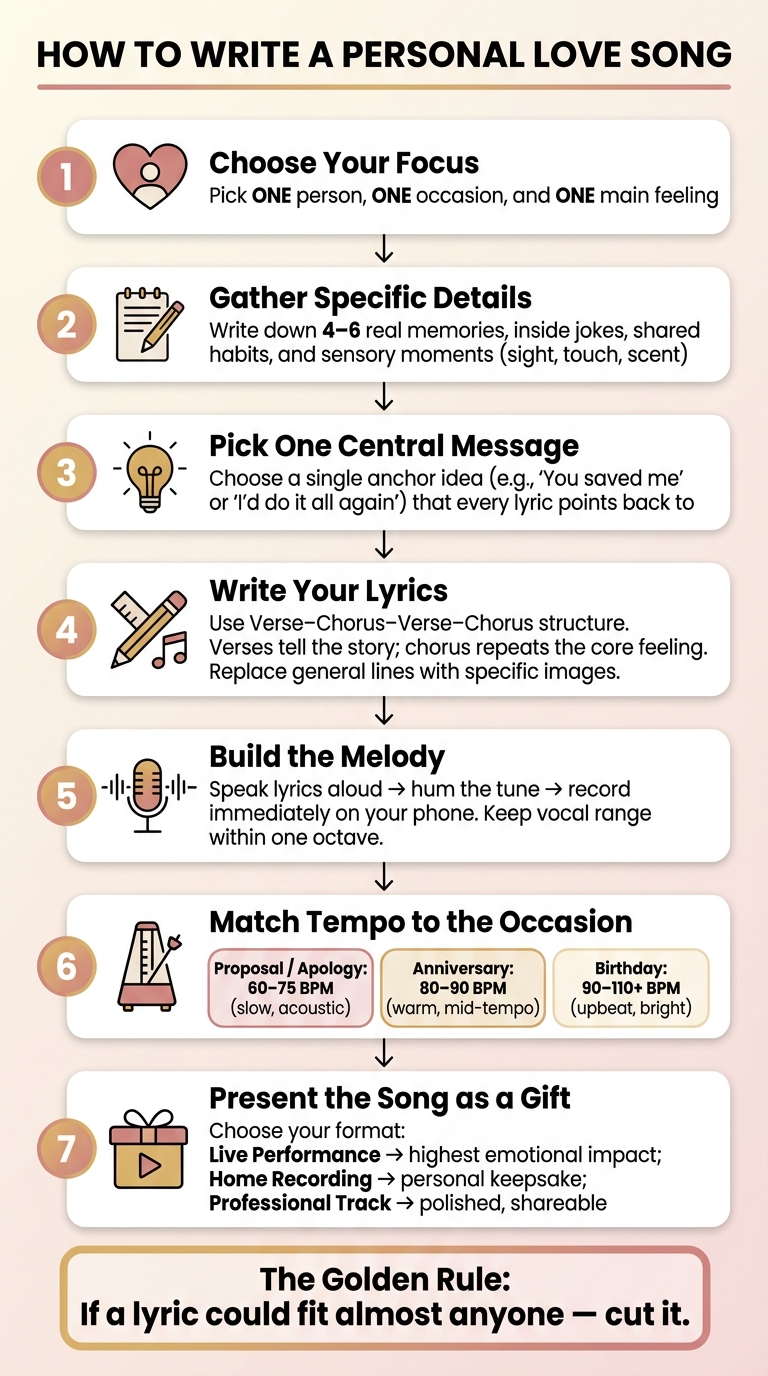
A personal love song works best when I keep it simple: one feeling, 4–6 real details, a short structure, and an easy melody. I don’t need fancy lyrics or a big vocal range. In most cases, staying within about one octave makes the song easier to sing, and a clear tempo - around 60–80 BPM for tender moments or 90–110 BPM for happier ones - helps set the mood fast.
Here’s the short version:
- I pick one person, one occasion, and one main feeling
- I write down small shared moments, inside jokes, places, and habits
- I choose one main message for the whole song
- I use verses for story and a chorus for the main line
- I say the lyrics out loud, hum a tune, and record ideas right away
- I keep the melody easy and the key comfortable
- I choose how to give it: live, home recording, or a produced track
A good song gift is not about polish. It’s about specific lines, plain emotion, and a melody I can sing without strain. If a lyric could fit almost anyone, I cut it. That one rule does most of the work.
How to Write a Personal Love Song: Step-by-Step Guide
How to Write a LOVE SONG That Isn't Corny! Song Hack | DAWter
sbb-itb-962b02b
Quick Comparison
| Part | What I focus on | Best simple rule |
|---|---|---|
| Idea | Person, event, feeling | Pick one core emotion |
| Details | Memories, jokes, habits | Use 4–6 specific details |
| Lyrics | Story + main message | Verses tell; chorus repeats |
| Melody | Natural speech pattern | Speak, hum, then record |
| Music feel | Tempo and key | Match speed to the moment |
| Gift format | Live or recorded | Pick what they can keep |
If I want the song to mean more, I make it more personal - not more complicated.
Gather the Details That Make the Song Specific
Now take that feeling and turn it into details that belong to your relationship. That’s what makes a gift song hit home. If a line could fit almost anyone, cut it.
Write Down Milestones, Small Moments, and Inside Jokes
Before you start writing, make a short list of details. Add milestones, nicknames, shared habits, and sensory moments. Stick to 4 to 6 details - enough to make it personal without turning the song into a checklist.
Small moments usually land harder than broad lines. Instead of saying, “You’ve always been there for me,” say, “You waited in the porch light till I pulled in at midnight.” Instead of, “I love your kindness,” say, “You folded my school note and hid it in my lunch.” That’s the kind of detail that feels lived-in.
A coffee order, a favorite road trip, or a word they always mispronounce can do the same thing. These little things give you lyric lines that sound like your life, not a generic card.
Try to pull in one detail for sight, touch, and scent from a key memory. Those sensory cues make the scene feel alive and give you lines you can build on.
It also helps to include one hard season. That adds depth and honesty.
From that list, pick the one idea the whole song will keep coming back to.
Pick One Central Idea for the Song
Once you have your list, choose one anchor message - “You saved me,” “I’d do it all again,” or another single idea that can carry the full song. If you try to say everything at once, the song starts to drift. Pick the angle that feels most true right now, then let each detail point back to it.
That anchor will guide the lyrics in the next step.
Write Honest Lyrics Using a Simple Structure
With your anchor idea and details ready, draft fast and keep the first version simple.
Use Verses for Story and the Chorus for the Main Feeling
Think of the song as doing two different things in two different sections. Verses tell the story - the names, places, memories, and small details from your list. The chorus carries the main emotion - the feeling you want the other person to hear and remember.
A simple setup is Verse-Chorus-Verse-Chorus-Bridge-Chorus. If you want to keep it more personal and a little shorter, use Verse-Chorus-Verse-Chorus. The bridge is optional. Add it only if the song needs a shift in mood or point of view.
| Section | What It Does | Quick Tip |
|---|---|---|
| Verse | Sets the scene and carries specific details | End on an open rhyme to lead into the next line |
| Chorus | States the core feeling and repeats the anchor message | Keep it short and repeatable |
| Bridge | Shifts perspective or adds emotional contrast | Optional - use it for contrast or a shift in perspective |
Once you have the structure, take one memory and turn it into a line. Let the chorus hold the main feeling.
Turn Real Memories into Lyric Lines
Start with one detail from your list and write it as a plain sentence. Then shape that sentence into a lyric. For example: "You make pancakes the way your dad did and save the first one for me."
A few prompt starters can help when your mind goes blank:
- _"I knew I loved you when…"
- "You always…"
- "I still remember…"
- "If I could say one thing clearly…"_
These push you toward moments you can see and hear, not vague emotions. That matters. Specific details stick with people and make the song feel personal.
Trade general statements for images. Instead of "You've always been so kind," try "You sat with me in the car for 40 minutes outside the hospital." One line explains. The other puts the listener right there with you.
If you have too many memories, don't cram them all in. Pick one main scene and build it fully. If that memory has a turning point, center the verse on that moment.
Edit for Clarity, Rhythm, and Emotional Truth
Once the draft says what you mean, cut anything that slows it down.
Read each line out loud. If a line feels stiff or awkward in your mouth, it'll probably be even harder to sing. Rewrite anything that doesn't sound like something you'd actually say to this person.
Here's a simple test: if you can't picture yourself saying the line in a casual moment, fix it. Cut filler, shorten long phrases, and count the syllables aloud to spot lines that break the flow. Slant rhymes usually sound better than perfect rhymes that feel forced.
Keep the chorus focused on your strongest phrase or anchor message. If one line feels the clearest and most emotionally honest, make that the line people remember.
Build a Melody and Finish a Singable Version
With the lyrics done, the next step is turning them into a tune that feels natural to sing.
Find a Melody by Speaking, Humming, and Recording
Start by saying the lyrics out loud. Listen to how the line rises and falls on its own. That natural speech pattern often gives you the first outline of the melody.
Then hum the line back without the words. This is a simple trick, but it works. Humming lets you hear the tune more clearly before chords start pulling it in different directions.
When a phrase clicks, record it right away in your phone’s voice memo app. Good ideas can disappear fast, and this saves you from trying to remember a melody later.
Keep it simple. A melody doesn’t need a lot of twists to work. In fact, a clear phrase that comes back in the chorus is often stronger than a tune that tries to do everything at once. You’re not aiming for a stock love song. You want something that sounds like this person and this moment.
Use Simple Chord Progressions and Beginner Tools
A four-chord loop is a solid place to start. It gives the song a steady base and usually feels familiar right away. Once you have that loop, try singing the melody over it with a recording app or a chord app.
It also helps to keep the vocal range tight. Staying within one octave is a good target for most non-professional singers. That makes the song easier to perform and a lot easier for the other person to sing along with.
Match the Music to the Occasion
The music should support the feeling already built into the lyrics. If the message is personal or serious, a slower tempo can help it land. Around 60–80 BPM works well for apologies, proposals, or other close, emotional moments.
If the song is meant to feel light, happy, or celebratory, go faster. A tempo in the 90–110 BPM range fits birthdays, anniversaries, and other upbeat occasions.
| Occasion | Tempo Range | Suggested Feel |
|---|---|---|
| Proposal | 60–70 BPM | Slow, acoustic ballad, major key |
| Anniversary | 80–90 BPM | Warm, mid-tempo, soulful |
| Birthday | 90–110+ BPM | Upbeat, bright major sounds |
| Apology | 60–75 BPM | Soft, conversational, understated |
Pick a key that feels easy in your singing range. If the high notes feel strained when you practice, bring the key down. It’s better to sound relaxed and steady than to reach for notes that don’t sit well.
Present the Song as a Gift
Once the song is done, the reveal is what turns it from a performance into a keepsake. The way you present it should fit the feeling already built into the lyrics.
Choose How to Give the Song
How you give the song shapes how it lands. A live performance hits hardest in the moment, but if no one records it, that moment can slip away. A home recording gives the other person something they can play again. A professionally produced track gives you a polished keepsake that you can share or even pair with framed lyric art.
| Format | Time Required | Musical Skill Needed | Emotional Impact | Keepsake Value |
|---|---|---|---|---|
| Live Performance | Low to Medium (practice) | High | Very High | Low unless filmed |
| Home Recording | Medium | Moderate | High | High |
| Professional Custom Recording | Low (often 24 to 48 hours) | None | High | Very High |
For a quiet reveal, go with an intimate setting. A handwritten note that explains what the song means can add weight to the moment. You can also pair the audio with a photo slideshow or a simple music video, matching photos to key lyric lines.
If you want something they can hold onto right away, a few options work well:
- A private link
- A QR code inside a card
- A framed lyric print
Pick the format that fits the moment and the kind of memory you want them to keep.
Use Song to Gift When You Have the Story but Need the Finished Song

If you have the story but not the tools, a finished version can still feel deeply personal.
Not everyone is ready to sing or produce a track, and that's completely fine. If you have the memories, the details, and the feeling but not the musical skills to bring it all together, Song to Gift is built for that exact situation. You submit the occasion, inside jokes, milestones, and tone, and the song is turned into a studio-quality track in 24 to 48 hours. Add lyric art if you want a display piece.
Conclusion: Keep It Specific, Simple, and True
Keep it specific, simple, and true: one clear feeling, a few real details, and a melody that feels natural to sing.
FAQs
How long should a personal love song be?
There’s no strict rule for song length. What matters most is the emotional impact and making sure your message feels complete without getting repetitive.
Put your energy into a clear structure, meaningful lyrics, and specific memories that feel personal and lived-in. A heartfelt song can connect with people no matter how long it runs.
What if I can’t sing or play an instrument well?
You don’t need to be a musician to make a song that hits hard. The person who gets it won’t be grading your skill. What will move them is the effort you put in and the personal story you tell.
Start with the raw material: honest memories, inside jokes, and small, specific details that mean something to both of you. That’s the stuff that gives the song heart.
If you want help, you can work with a professional songwriter. Or you can write your own lyrics and try them over existing melodies to see how the rhythm feels.
How do I make the song personal without sounding cheesy?
Focus on specific details instead of broad romantic lines. A lyric about a real habit, an inside joke, or a shared memory will land better than something generic. Even four to six personal references can make the song feel tied to your relationship, not just love songs in general.
Bring in sensory details too. Think about sounds, weather, smells, or even what someone was wearing. Those small touches make a line feel lived-in. And keep the wording simple and honest. If a lyric sounds clunky or cliché when you read it out loud, swap it for the kind of words you'd use in everyday conversation.