
Checklist: How to Plan a Truly Memorable Gift
The best gift is not the most expensive one. It’s the one that feels personal, fits the moment, and is easy to remember later.
If I were planning a gift, I’d keep it simple and focus on six things:
- The occasion: birthday, anniversary, wedding, retirement, sympathy, or “just because”
- The feeling: pick one main emotion, like joy, comfort, pride, or closeness
- The deadline: if I have under 48 hours, digital is often the safest route; if I have 7–10 days, I have more room to plan
- The person: their habits, space, needs, likes, dislikes, and comfort with public attention
- The story: choose 3–5 specific memories, names, dates, jokes, or lines that mean something to us
- The format and reveal: match the gift type, budget, and the way I plan to give it
A simple gift can hit harder than a $100+ item if it points to a shared memory. And if I’m using something like a song, letter, or digital file, I’d also save a backup copy, print lyrics or notes, and make replay easy with a card or QR code.
Here’s the short version: start with the person, not the product. Then line up the date, message, memory, budget, and reveal so the gift feels clear instead of messy.
| Part | What I’d decide first |
|---|---|
| Occasion | Why I’m giving it now |
| Emotion | The one feeling I want it to leave |
| Timeline | How many days I have left |
| Recipient | What fits their life and comfort level |
| Shared story | 3–5 memory points to build from |
| Format | Song, letter, keepsake, or memory book |
| Presentation | Private or public, quiet or group setting |
| Backup plan | Extra copy, printout, or saved file |
If I check those boxes before I buy anything, I’m much more likely to give a gift that sticks.
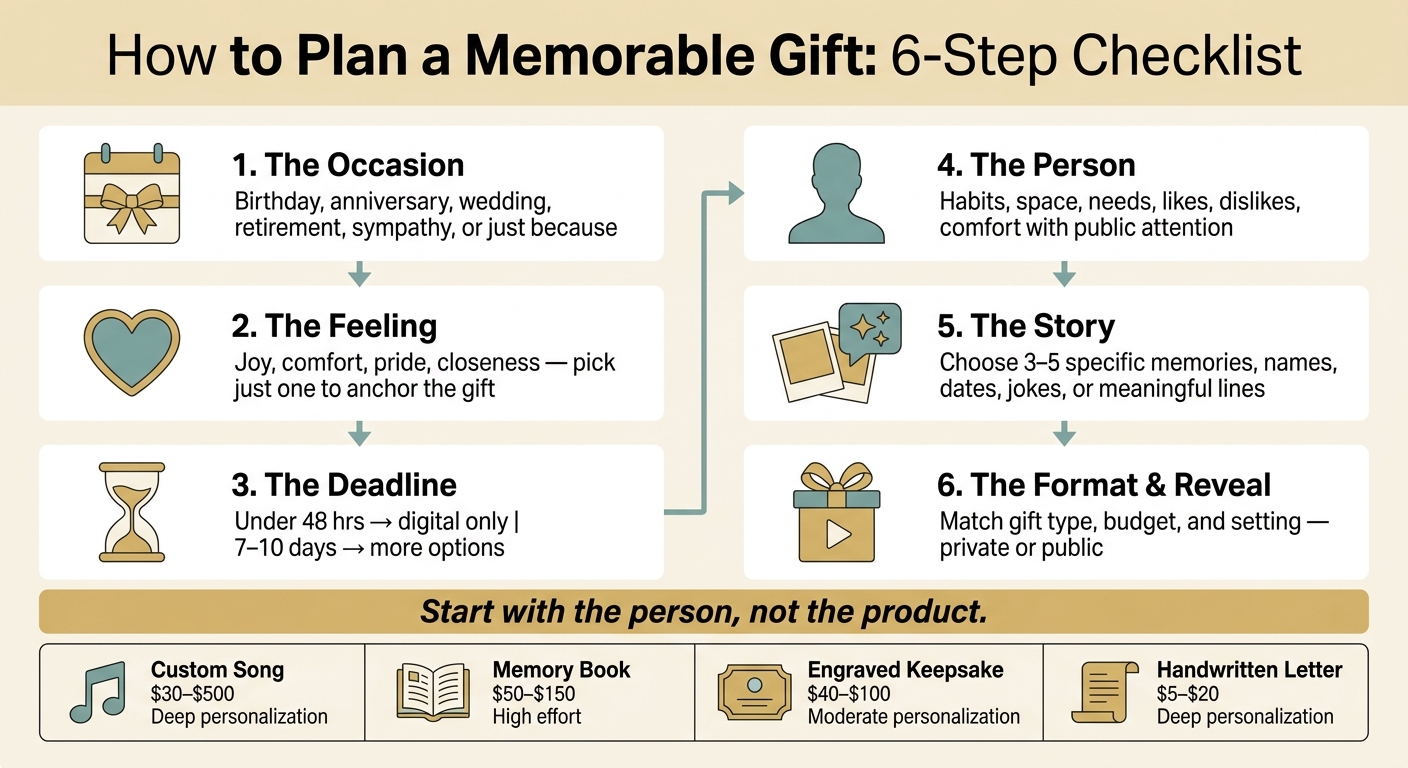
How to Plan a Memorable Gift: 6-Step Checklist
1. Clarify the Occasion, Intent, and Timeline
Before you pick the format, get clear on why you're giving the gift, what feeling you want it to spark, and how much time you have. A clear timeline helps protect the emotional punch of the reveal.
Choose the Occasion and the Emotion Behind the Gift
Every occasion carries its own emotional weight, so the gift should fit the moment. A retirement gift should reflect acknowledgment and pride. A sympathy gift calls for tenderness and comfort. A "just because" gift works best when it leans into surprise and connection.
Choose one main emotion to anchor the gift. Maybe it's something like "You make ordinary days feel like home." Let that idea guide the format, tone, and details. If you try to pack in gratitude, nostalgia, humor, and romance all at once, the message can start to feel all over the place.
| Occasion | Primary Emotion | Best Reveal |
|---|---|---|
| Birthday | Joy, celebration, humor | Party or morning surprise |
| Anniversary | Gratitude, nostalgia | Intimate dinner or quiet home moment |
| Wedding | Romance, awe, legacy | Reception or ceremony |
| Retirement | Acknowledgment, pride | Work event or group gathering |
| Sympathy/Memorial | Comfort, tenderness | Private family setting or service |
| "Just Because" | Surprise, connection | Casual daily moment (e.g., car ride) |
Confirm the Delivery Date and Planning Window
Start with the event date, then work backward to find your actual planning window.
Personalized digital gifts, such as custom songs, can be delivered in as little as 24 to 48 hours. Still, even when turnaround is fast, it's smart to give yourself at least 7–10 days when you can. That extra room gives you time for lyric revisions and reveal prep.
If the event is less than 48 hours away, keep it digital only. A shareable link or a QR code sent by email is often the simplest path.
Note Privacy, Family Dynamics, and Cultural or Language Preferences
Start with one basic question: public or private? Some people love being celebrated in front of a crowd. Others would rather have a quiet moment at home. The same gift can feel warm and memorable in one setting, and a bit too much in another.
It also helps to decide what stays out. Leaving out ex-partners, past hardships, or religious themes that don't fit can keep the gift focused and protect the reveal. If the recipient has a specific cultural or linguistic background, think about whether a bilingual touch would feel more personal - or just off.
With the occasion and timing in place, the next step is to shape the gift around the recipient's story and the details that matter most.
sbb-itb-962b02b
2. Build the Gift Around the Recipient and Your Shared Story
Use the occasion and timeline you already picked to gather the details that make the gift unmistakably theirs.
Profile the Recipient in Practical Details
Start with the basics before you get sentimental. Think about their day-to-day life and what they can comfortably keep or use. Do they live in a small apartment with almost no storage, or do they have room for keepsakes? Note the practical limits early: allergies, mobility needs, age, location, and the type of gift they can actually use. Those details help you avoid giving something awkward, useless, or off-base.
| Detail Category | What to Note |
|---|---|
| Practical details | Relationship, age, location, hobbies, lifestyle limits like allergies, storage, or mobility |
| Signature quirks | Favorite phrases, nicknames, inside jokes, secret places, and then-vs.-now contrasts |
List Emotional Keywords, Favorites, and Inside References
Write down 3–5 words that honestly describe this person. Skip the polished compliments. Go for the words that feel like them. These details shape the tone, wording, and format of the gift.
Then make note of their favorite music genres, go-to foods, meaningful places, and the names, places, dates, nicknames, or repeated phrases that make the story clearly theirs.
A line like "He steals fries off my plate and acts shocked when I notice" does more work than a generic line like "he has a great sense of humor."
Choose 3–5 Shared Memories to Anchor the Gift
This is where the gift starts to carry some emotional weight. Jot down 6–10 moments, then narrow the list to 3–5. Pick scenes, not summaries. "The night we sat on the tailgate and watched the storm roll in" hits harder than "we have so many great memories together."
Look for moments with texture: a smell, a sound, a small image that takes you straight back. A first meeting, a rough season you got through, an apology that changed things, or a reunion after time apart can all work well. Concrete details give a personalized gift a story to tell - one the recipient will spot right away as their own.
Once those story details are in place, choose the budget and format that can carry them.
3. Set a Realistic Budget and Pick the Right Gift Format
Once you have the story details, the next step is simple: figure out what you can spend and pick a format that fits both your budget and your deadline.
The goal here isn't to do the most. It's to choose a gift format that can carry the story well without turning the whole thing into a stressful scramble.
Choose Your Budget, Scope, and Time Commitment
Break your budget into four parts:
- the core gift
- presentation like packaging or framing
- add-ons like flowers, a card, or a small treat
- shipping or delivery
Physical keepsakes and memory books can bring extra shipping and presentation costs. You can often skip rush fees by ordering 7–10 days ahead for standard projects or 4–6 weeks ahead for more involved ones.
It also helps to decide the gift structure early. You can go with one main gift, one main gift plus a small supporting item, or a short set of coordinated surprises. In most cases, simple works better than trying to pile on too much at once.
Once the budget is clear, pick the format that fits the person and the occasion.
Match the Format to the Recipient and Occasion
Choose the format based on the recipient, the moment, and your timeline. A memory book can work well for someone with a long shared history, like a long-term partner or a graduating child, but it takes time to pull together. Plan on 1–2 weeks and a budget of $50–$150. An engraved keepsake is much easier to order and usually ships in 3–7 days for $40–$100, though the personalization is often limited to a name or date. A handwritten letter set costs very little and can be ready right away.
The big idea: match the format to how much story you want the gift to hold.
| Gift Format | Personalization Depth | Effort Level | Typical Budget (USD) |
|---|---|---|---|
| Custom Song | Deep (lyrics, story) | Low (provide details) | $30 – $500 |
| Memory Book | Deep (photos, text) | High (curation) | $50 – $150 |
| Engraved Keepsake | Moderate (name, date) | Low (order entry) | $40 – $100 |
| Handwritten Letter Set | Deep (personal) | Moderate (writing) | $5 – $20 |
Choose a Personalized Song for the Main Emotional Moment
Use a personalized song when you want the gift to land around one clear emotional message.
A custom song makes sense when the occasion matters a lot, the feelings run deep, and you want something the recipient can come back to again and again. For a custom song, include the recipient's name, the occasion, the date, 3–5 memories, nicknames, mood, and genre. A specific brief usually means fewer revisions and a better end result.
Then move to the reveal plan.
4. Plan the Reveal, Preserve the Memory, and Recap the Checklist
Plan the Best Time, Place, and Reveal Sequence
With the gift picked and shaped, the next step is the moment itself.
Try to match the setting to the way the recipient likes to receive personal moments. If they lean private, a quiet dinner, a one-on-one morning surprise, or a short drive can work well. If they love attention, a family gathering or party may fit better.
One strong choice is the car ride reveal. It gives you privacy, keeps the other person focused, and makes music feel natural in the moment.
Whatever setting you choose, keep the intro short - 30 seconds max. Ask them to listen all the way through so they don’t miss the most personal parts, since those often show up later in the verses or bridge.
Before you hit play, do a quick check:
- Speaker
- Internet access
- Room noise
That small prep can save you from an awkward, “Wait, it’s not loading,” right in the middle of the reveal.
Create a Way to Revisit the Gift After the Event
Once the moment lands, make sure the gift doesn’t vanish with it.
The reveal is short. The memory doesn’t have to be. With a custom song, replay is part of what makes the gift matter. Save the audio in more than one place so it doesn’t disappear if a link expires. Print the lyrics or save them as a PDF so the recipient can read the words without needing to press play.
A few simple ways to make the gift easier to revisit:
- Add a QR code to a card or photo album for easy replay
- Record the reaction quietly, since that response often becomes part of the memory
- Bring the song back on birthdays or anniversaries so it becomes part of your shared story
Conclusion: A Simple Checklist for a Gift They Will Remember
Before you wrap things up, do one last pass through the basics:
- Occasion and intent: What is the moment, and what emotion do you want to leave behind?
- Recipient profile: What are their interests and comfort level with public vs. private moments?
- Shared memories: Have you chosen 3–5 specific memories to anchor the gift?
- Budget and format: Does the format match the depth of the story you want to tell?
- Presentation plan: Do you know the setting and timing?
- Preservation plan: Is there a backup copy, a printed version, or a physical keepsake ready?
The gifts people remember most usually aren’t the ones with the biggest price tag. They’re the ones that show you paid attention, knew the person’s story, and took the time to honor it.
FAQs
How do I choose the most meaningful gift format?
Choose a format that feels like them.
The best gift doesn’t lean on generic compliments. It reflects shared history, inside jokes, and specific memories that only the two of you would know. That’s what gives it weight.
It also helps when the gift can stick around as a keepsake they can return to later, not just a one-time moment. A custom song, memory book, or personalized letter can do that well.
Match the format to their personality, then fill it with details that will still mean something years from now.
What if I’m short on time but still want it to feel personal?
If time’s tight, forget the big gesture and lean into specific, honest details that only you and the other person would know. That’s what makes a gift feel thoughtful. It points to a shared story, not some generic, off-the-shelf feeling.
Take 10 minutes and jot down a few things:
- a specific memory
- a nickname only you use
- an inside joke
- a habit they always fall into
Those small details show you were paying attention. And most of the time, that lands better than perfect timing.
How can I make a gift feel special without spending a lot?
Focus less on buying stuff and more on the small, personal touches that actually mean something. The gifts people remember most usually come from shared memories, inside jokes, and the little quirks that make your relationship your relationship.
Maybe that looks like a custom song, a photo montage you put together by hand, or a heartfelt handwritten letter. The point isn’t the price tag. It’s the thought, reflection, and care behind it.