
Ultimate Guide to Personalized Wedding Songs
A personalized wedding song works best when I match it to the right moment, keep the story tight, and plan playback early. In most cases, that means 60–90 seconds for a processional, 3:00–4:30 minutes for a first dance, and about 70–90 BPM if I need a song that feels easy to dance to.
Here’s the short version:
- Pick the moment first. A processional, first dance, parent dance, and private last dance each need a different tone.
- Use only 5–8 story details. Too many details can make lyrics feel crowded.
- Choose the right lyric style. Public moments often work better with softer, less literal lines. Private moments can hold more personal details.
- Match the sound to the setting. Acoustic fits quiet moments. Pop or R&B can fit entrances or first dances.
- Order early. I’d leave 2–4 weeks for review, edits, and playback tests.
- Send the final file to the DJ or venue at least 2 weeks ahead. Keep backups on a phone, USB drive, and cloud storage.
If I had to narrow it down even more, I’d focus on three things: fit the song to the wedding moment, keep the lyrics specific, and make sure the file works at the venue. That’s what turns a custom song from a nice idea into something people will remember.
The rest of this guide walks through those choices in plain terms, so it’s easier to decide what kind of song to make and how to use it on the day.
Make Your Wedding Day Extra Special with Custom Love Songs || Ultimate Guide to Custom Wedding Songs
sbb-itb-962b02b
Choose the Right Wedding Moment and Purpose
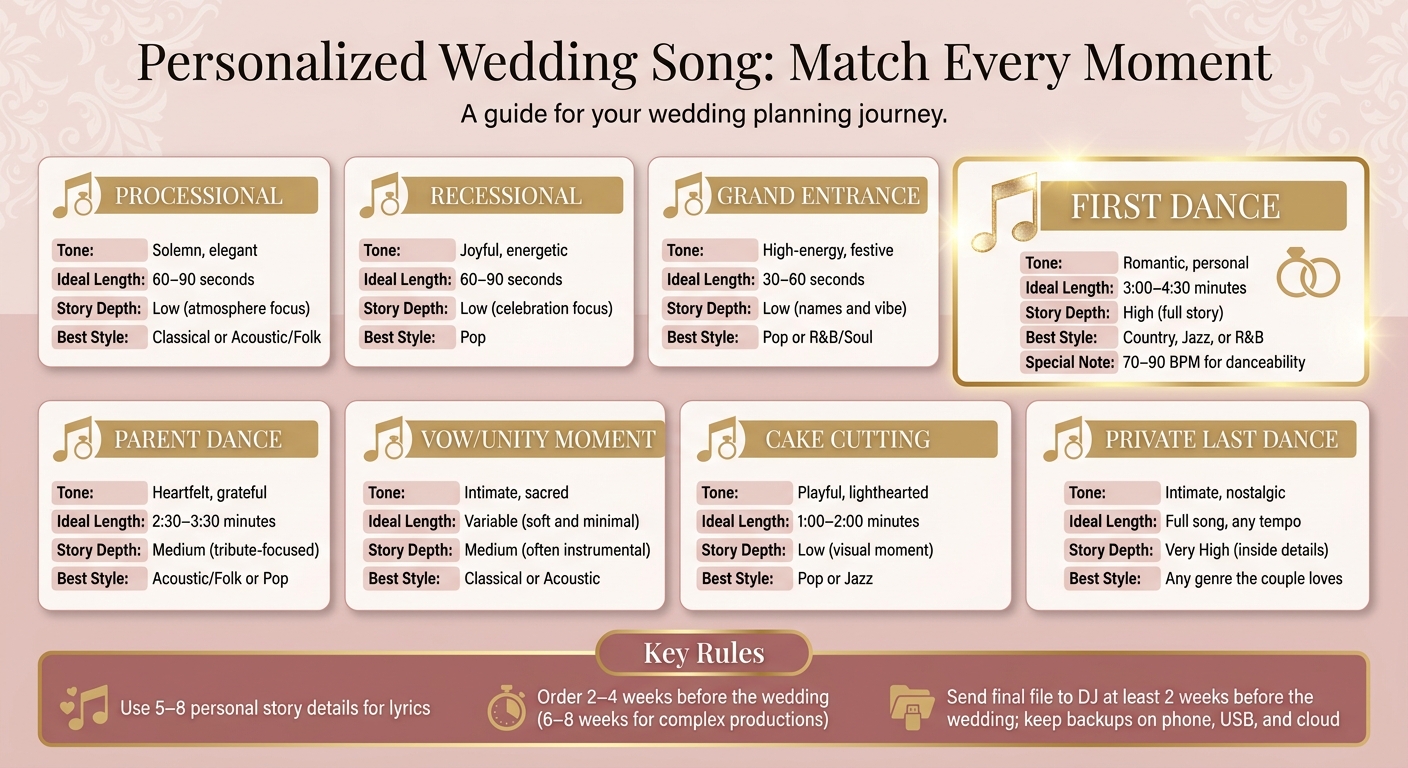
Personalized Wedding Song Guide: Moments, Length & Style
Next, pair the song with the moment it needs to carry. Not every part of a wedding asks for the same kind of music. A processional sets a scene. A first dance tells a story. A grand entrance just needs energy and a bit of swagger.
The goal is simple: match the mood, the audience, and the length of the song to the event.
Match the Song to Ceremony and Reception Events
Use the chart below to line up tone, length, and story detail with each part of the day.
| Wedding Moment | Tone | Story Depth | Audience | Ideal Length |
|---|---|---|---|---|
| Processional | Solemn, elegant | Low - atmosphere matters most | All guests | 60–90 seconds |
| Vow/Unity Moment | Intimate, sacred | Medium - often instrumental | All guests | Variable; soft and minimal |
| Recessional | Joyful, energetic | Low - celebration focus | All guests | 60–90 seconds; faster tempo |
| Grand Entrance | High-energy, festive | Low - names and vibe | All guests | 30–60 seconds |
| First Dance | Romantic, personal | High - the full story | All guests | 3:00–4:30 minutes |
| Parent Dance | Heartfelt, grateful | Medium - tribute-focused | All guests | 2:30–3:30 minutes |
| Cake Cutting | Playful, lighthearted | Low - visual moment | All guests | 1:00–2:00 minutes |
| Private Last Dance | Intimate, nostalgic | Very high - inside details | Couple only | Full song; any tempo |
For the first dance, a 70–90 BPM tempo keeps things easy to move to without making the moment feel rushed. For the processional, it helps to time the chorus so it lands before the walk ends. That little cue can make the whole moment feel polished instead of off by a few beats.
A private last dance is a smart pick when the lyrics get a little too personal for a room full of guests. If the song mentions specific text messages or tiny memories only the two of you would get, save it for that couple-only moment.
Decide Whether One Song or Multiple Versions Makes Sense
You don't always need a different song for every part of the wedding. Sometimes one song can do more than one job, as long as you ask for the right versions from the start.
For example:
- An instrumental version can work during the guestbook signing or a unity candle moment, where lyrics might pull focus.
- A softer acoustic mix can fit dinner.
- The full vocal version can be saved for the first dance.
That approach keeps the theme tied together without forcing the same exact track into every moment. It also saves you from scrambling to cut, trim, or swap versions the week before the wedding.
Build the Story, Lyrics, and Musical Style
Once you know when the song will be used, the next step is simple: figure out what it should say and how it should sound. A processional, a first dance, and a private gift each need a different kind of story.
Gather the Details That Make the Song Feel Personal
Don’t try to squeeze the entire relationship into one song. When you pile in too many memories, the song can lose the feeling at its core.
A good target is 5–8 specific details. Too few, and the song feels generic. Too many, and the lyrics start to feel cramped. Go with small details the couple will spot right away - a kitchen habit, an inside joke, or an accidental "I love you".
Then shape those details into a three-part arc: how you met, a shared challenge or milestone, and a promise about what comes next. That gives the song an emotional path instead of making it sound like a scrapbook set to music. For private moments, you can lean into more detail. For ceremony moments, it usually helps to pull back.
Here’s a simple gut check: if you’d write the detail in a private card but would never say it in a toast, it probably belongs in the song.
Once the story is in place, decide how literal the lyrics should be. Do you want direct memories, or a more polished, symbolic version of them?
Choose Between Direct Storytelling and Poetic Lyrics
Direct storytelling uses real names, real moments, and inside details. Poetic lyrics lean more on imagery and emotion, which can make the song feel more timeless. As a rule, the more public the moment, the more a softer and more universal style tends to work.
| Lyrical Style | Pros | Cons | Best Fit |
|---|---|---|---|
| Direct Storytelling | Highly personal; feels earned and specific | Can feel clunky if too many details are forced in | First dance, reception surprises, toasts |
| Poetic | Flows naturally; feels timeless | Can easily become generic | Processionals, unity ceremonies |
| Hybrid | Balances humor and specifics with an emotional finish | Requires careful tonal balance | Rehearsal dinners, parent gifts |
A hybrid style often works best for reception reveals. Start with something specific and a little funny to warm up the room, then turn toward something more moving once you have everyone’s attention.
That decision should shape the arrangement, vocal approach, and tempo too.
Match Genre, Tempo, and Vocals to the Wedding Moment
Genre, tempo, and vocal style change how a song lands in the room. They also decide whether it fits the moment or feels slightly off. Natural-sounding vocals matter here because they help keep the emotion intact.
| Genre | Typical Vibe | Best Wedding Moment |
|---|---|---|
| Country | Story-driven, handles love narratives well | First dance, reception surprise |
| Acoustic/Folk | Intimate, romantic, and stripped-back | Processional, private gift |
| Jazz | Elegant, timeless, and sophisticated | Formal first dance |
| Pop | Modern, flexible, and dependable | Recessional, grand entrance |
| R&B/Soul | Soulful and smooth | First dance |
| Classical | Premium, traditional feel | Processional, unity ceremony |
If you’re not sure a demo feels right, try listening to it while standing in your first-dance hold. That tends to make the answer obvious. You’ll feel pretty fast whether the pace is easy to move with or awkward.
It also helps to check the couple’s actual Spotify or Apple Music library before guessing on genre. What they listen to in daily life is usually a better guide than what looks wedding-friendly on paper.
After the sound is set, the next step is planning approval and delivery without wedding-week stress.
Order, Review, and Deliver the Song Without Last-Minute Stress
With the story, lyrics, and sound locked in, the last thing you want is chaos in the final days before the wedding. Getting the logistics handled early is what makes the reveal feel smooth instead of rushed.
Set a Realistic Timeline for Creation and Approval
Place the order 2–4 weeks before the wedding so you have time to review the track, request edits, and test playback. At that point, the focus shifts from making the song to getting it approved and delivered on schedule. If the production is more involved, give yourself 6–8 weeks so multiple revision rounds don't turn into a scramble.
That extra time helps you catch the small details that are easy to miss when stress kicks in.
| Review Category | What to Check | Target Specification |
|---|---|---|
| Names | Correct nicknames and pronunciations | Must be accurate |
| Length | Total runtime of the track | 3:00–4:30 min (first dance); 60–90 sec (processional) |
| Tempo | Beats per minute (BPM) | 70–90 BPM for danceability |
| File Format | Audio file type | MP3 for compatibility; WAV for the highest-quality file |
| Final Deadline | When to send to DJ or planner | At least 2 weeks before the wedding |
Prepare the Audio for U.S. Wedding Playback
Once the final file is approved, treat playback like a production detail, not an afterthought. Make backups in a few places:
- Cloud storage
- A USB drive
- Your phone
Send the file to your DJ or venue coordinator at least two weeks before the wedding. Include a note with the exact cue point so they know where to start the track.
Also, don't assume a song that sounds good in headphones will sound the same through venue speakers. If you can, test it during the rehearsal to make sure the volume and mix work in the room. This matters even more for outdoor venues, where sound acts differently than it does indoors.
Keep the Song as a Wedding Gift and Long-Term Keepsake
After the wedding, keep the song as part of the couple's story. If you want something visual to go with the audio, Song to Gift also offers digital wall art featuring the song lyrics.
You can also use digital wall art or a printed lyric insert to keep the song alive after the wedding. And if you want guests to follow along while it plays, print the lyrics in the wedding program.
Conclusion: What to Prioritize When Creating a Personalized Wedding Song
Once you’ve settled the moment, the story, and the sound, one thing still matters: will the song work on the day itself?
Start with the wedding moment. That choice does a lot of heavy lifting. A song for the processional needs a different shape and pace than one for the first dance or a private pre-ceremony gift. It affects the song’s job, its structure, its tempo, and how much detail makes sense to include.
From there, go for specificity instead of broad emotion. One sharp, personal detail often hits harder than a full recap of the relationship. A single memory can say more than a long summary ever could.
Then come the practical parts. Match the music to the setting. Acoustic often fits a garden ceremony well, while jazz can feel right in an elegant ballroom. If the song is meant for a first dance, the tempo should be easy to move to, usually 70–90 BPM, so it feels natural and is usable in the moment. Give yourself enough lead time for review, approval, and playback checks. A personalized wedding song only lands if the moment around it does too.
FAQs
How personal is too personal?
There’s no such thing as too personal in a wedding song. In fact, the more specific you get, the more meaning the song can carry.
That said, if you plan to share it in public, don’t pack it with inside references that guests won’t get. The songs people remember most tend to focus on the small, one-of-a-kind details that show what your relationship is all about.
Can one wedding song be used for multiple moments?
Yes. One personalized wedding song can work in more than one part of your celebration.
A lot of couples use it for a big moment, like the first dance or the ceremony. But since you get a digital audio file, you can also play it at the rehearsal dinner, give it as a private gift, or bring it back on anniversaries.
What should I send my DJ or venue?
Send your studio-quality song file to your DJ at least two weeks before your wedding. Don’t count on handing over a phone at the reception and hoping it works.
Play it safe by sharing the file in more than one way, such as:
- Cloud storage
- USB drive
It also helps to test the audio through the venue’s PA system ahead of time. A song can sound great on your headphones or home speakers, then land very differently in a larger room.