
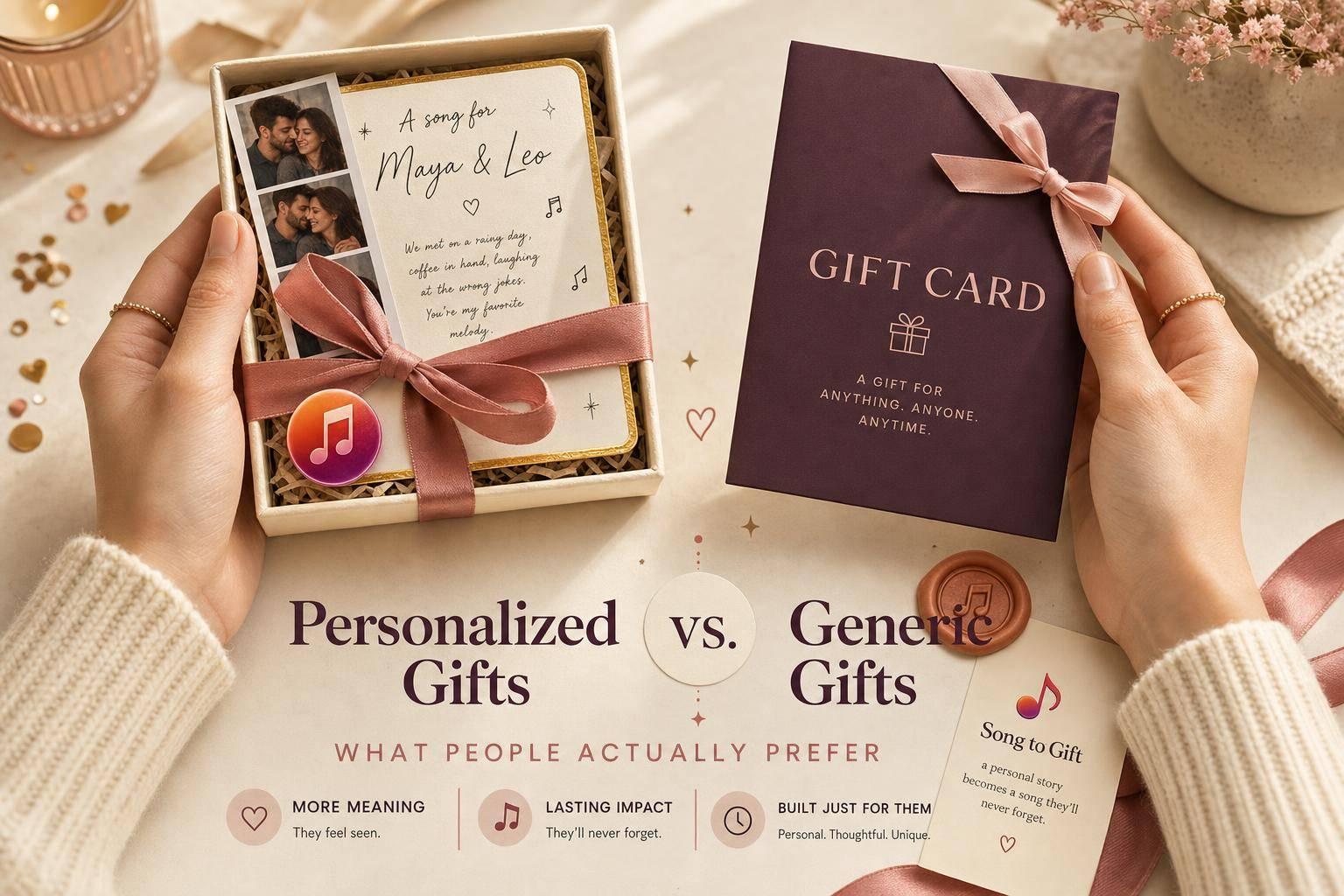
Personalized Gifts vs. Generic Gifts: What People Actually Prefer
Most people prefer the right gift for the moment, not one gift type every time. If I’m buying for a partner, close friend, or family member, a personalized gift usually hits harder. If I’m buying for a coworker, acquaintance, or need something fast, a generic gift is often the better pick.
Here’s the short version:
- Personalized gifts feel more personal and are more likely to be kept.
- Generic gifts are easier to buy, easier to use, and often fit work or group settings better.
- In 2026, shoppers spent about $94.50 on personalized gifts vs. $44.10 on generic ones.
- Personalized items are kept far longer: 81% are still owned after five years, compared with 15% of generic gifts.
- Lead time matters too: many personalized gifts need 10 to 18 days, so last-minute shopping often points to generic gifts.
If I had to boil it down to one rule, it’s this: pick personalized for memory, and pick generic for use. That one idea covers birthdays, anniversaries, weddings, holidays, budget, timing, and even personality.
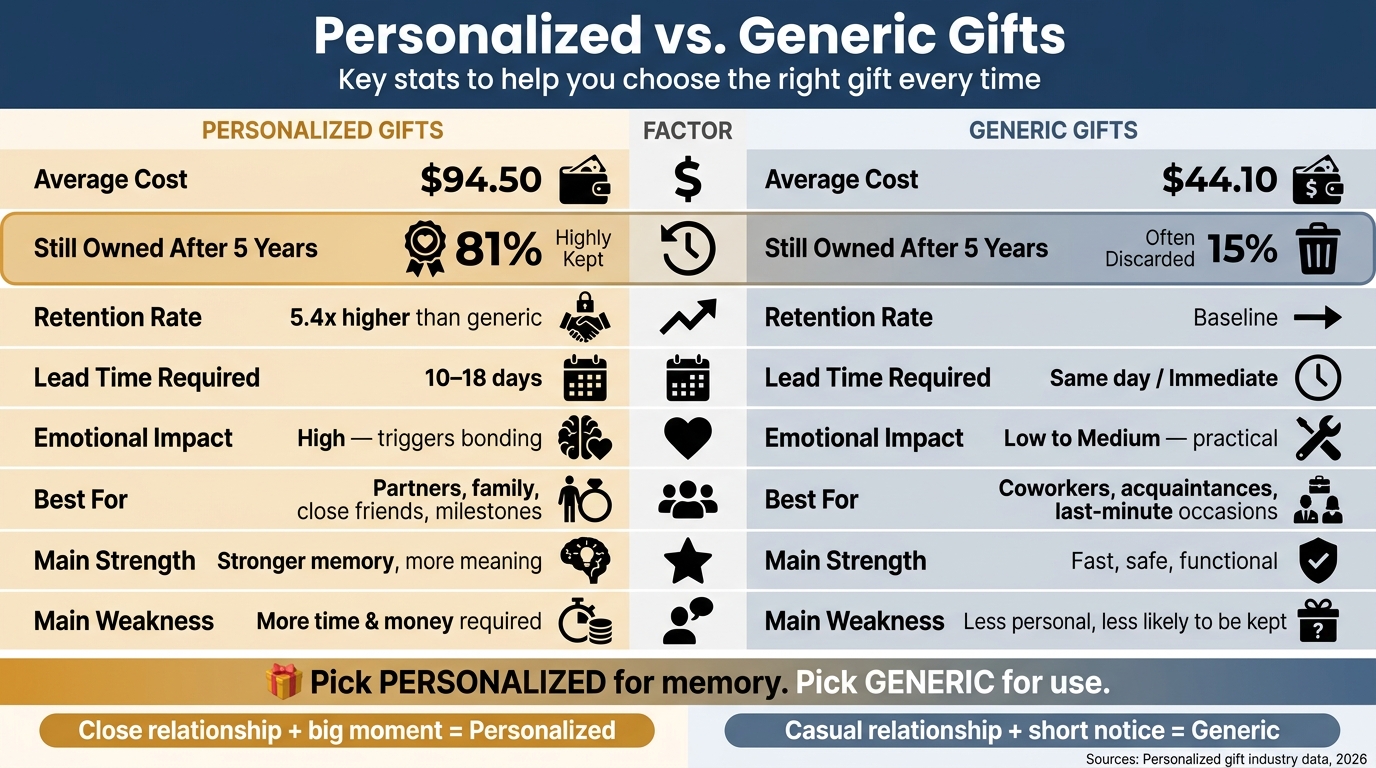
Personalized vs. Generic Gifts: Key Stats & When to Choose Each
Personalized Gifts: How to Choose Unique Engraved Gifts That Last
sbb-itb-962b02b
Quick Comparison
| Gift Type | Best For | Main Strength | Main Weakness | Average Cost |
|---|---|---|---|---|
| Personalized gifts | Partners, family, close friends, milestones | More meaning, stronger memory | More time, more money, higher chance of missing if done poorly | $94.50 |
| Generic gifts | Coworkers, acquaintances, last-minute occasions, group events | Fast, safe, useful | Less personal, less likely to be kept | $44.10 |
A simple way to choose:
- Close relationship + big moment = personalized
- Casual relationship + short notice = generic
- Sentimental person = personalized
- Practical person = generic
- Need a memory = personalized
- Need something useful now = generic
That’s the full answer in plain English before the article gets into the details.
Personalized Gifts vs. Generic Gifts: Key Differences
Recipients keep personalized gifts at a rate 5.4x higher than generic ones. 81% of personalized items are still owned five years later, compared with 15% of generic gifts. That’s a huge gap, and it points to something simple: personalized gifts tend to stick around because they feel tied to the person receiving them.
That doesn’t mean one gift type wins every time. It means the best pick depends on the moment. The gap becomes clearer when you look at emotion, usefulness, timing, and cost.
| Gift Type | Emotional Impact | Usefulness | Time Required | Typical Cost (USD) | Best Relationship Fit | Likelihood of Being Kept |
|---|---|---|---|---|---|---|
| Personalized | High - triggers bonding | Mostly sentimental | 10–18 days lead time | ~$94.50 | Close friends, family, partners | 81% kept after five years |
| Generic | Low to medium - practical but less personal | High - practical, functional | Immediate/Same day | ~$44.10 | Coworkers, acquaintances | 15% kept after five years |
Those trade-offs explain why the better choice can shift from one occasion to the next.
Why personalized gifts feel more meaningful
A name on an item isn’t what makes it land. The deeper point is attention. Good personalization shows that you noticed something about the other person and acted on it.
The strongest personalized gifts go past a label. They show that you were listening and that you understood something about the recipient’s identity. That’s why these gifts often feel warmer and more memorable, especially in close relationships.
Why generic gifts are often easier and more useful
Generic gifts have a clear edge: they’re fast, safer, and often more practical. If someone can use the gift every day, that can matter more than a personal touch.
In plenty of cases, a useful generic gift beats a poor personalized one. That’s especially true for coworkers, neighbors, or people you don’t know that well. In those settings, a solid generic gift is often the smarter move.
When a generic gift is the better choice
Personalization can miss the mark in a few cases. If you’re short on time, most personalized items need 10–18 days of lead time, so they’re often out for last-minute gifting.
It can also feel like too much for workplace exchanges or big group events, where personal details may seem awkward or hard to manage at scale. And for a minimalist who likes clean, plain items, adding a name or date may feel less like a nice touch and more like clutter.
The right choice comes down to the occasion, the relationship, and whether memory or utility should come first.
What Recipients Prefer by Occasion
The occasion changes everything. A custom song might land perfectly for an anniversary, but feel like too much for an office holiday exchange. People don’t want one kind of gift every time. They want the gift that fits the moment.
Here’s the simple rule: personal gifts tend to work best for personal occasions; practical gifts tend to work best for shared occasions.
| Occasion | Expectation | Ideal Gift Type | Best for |
|---|---|---|---|
| Milestone Birthday | Life stage recognition | Keepsakes, custom songs | Immediate family, best friends |
| Anniversary | Romantic effort | Engraved keepsakes, custom songs | Spouses, long-term partners |
| Wedding (Registry) | Practical home needs | Kitchen appliances, linens, cash | Acquaintances, coworkers, extended family |
| Wedding (Keepsake) | Lasting memory | Custom art, engraved heirlooms | Close family and friends |
| Holidays | Care and connection | Personalized for inner circle; generic for everyone else | Tiered by closeness |
Birthdays and anniversaries: the case for personalized gifts
Birthdays and anniversaries are where personalization tends to pay off most. Together, they account for 36% and 21% of all personalized gift orders, respectively.
For milestone birthdays like a 40th, 50th, or 60th, many gifts are ordered 30+ days in advance. That timing says a lot. A custom song or engraved keepsake shows planning, care, and attention.
And in these cases, effort can matter more than price. A $40 personalized item can beat a $300 generic luxury gift because it says, “I know you,” instead of just, “I spent money”. That’s the whole point here. The gift isn’t mainly about use. It’s about the memory it leaves behind.
For casual birthdays with coworkers or distant acquaintances, the math changes. A practical generic gift or gift card usually fits better.
Weddings and engagements: registry needs vs. memory value
Weddings split gift choices into two lanes: registry utility for most guests and memory value for the people closest to the couple.
If you’re not close, stick to the registry or give cash. That’s usually the safest move. The couple has asked for items they’ll use, and there’s no need to overthink it.
If you are close - a best friend, sibling, or parent - a personalized keepsake can add something a blender never will. Custom art or engraved heirlooms tie the gift to the day itself in a way registry items usually can’t. They’re less about function and more about what the moment means.
There’s one practical detail worth noting: lead time for wedding-related personalized gifts is about 21 days. So if you go that route, don’t wait until the last minute.
Holidays: balancing care, budget, and volume
Holidays are different because most people are buying for a mix of close and not-so-close relationships. That’s why a tiered approach makes sense.
For partners and immediate family, personalized gifts tend to connect better. 62% of Americans say they prefer gifts that feel personal and come from the heart over expensive retail items.
For coworkers, extended relatives, or people you don’t know all that well, a practical generic gift is usually the lower-risk option. It’s simpler, easier on the budget, and less likely to miss the mark. And if you want to add a human touch, a generic gift paired with a handwritten note can still feel warm and thoughtful.
At the end of it, the choice comes back to one idea: is this gift meant to create a memory or meet a need?
How to Choose Based on Relationship, Budget, and Personality
Once you know the occasion, look at three things next: your relationship, your budget, and the recipient’s personality. Those three filters make the choice a lot easier. They help you land on a gift that either creates a memory or solves a day-to-day need.
How close the relationship should shape how personal the gift is
Start with relationship closeness. In plain English: the closer you are, the more personal the gift can be.
For coworkers, acquaintances, and professional contacts, a polished generic gift is usually the safer move. It feels thoughtful without getting too personal. If the relationship sits somewhere in the middle - say, a friend you like but don’t know deeply - a solid generic gift with a handwritten note can hit the sweet spot. That small note adds warmth and shows intent without crossing a line.
How budget and timing affect perceived value
Budget can change the answer fast. If you have the time and money, a personalized gift often makes sense. If you’re short on either one, a generic gift is usually the better call.
Here’s a simple way to think about it:
- Under $50: A personalized mug ($12.99+) or custom luggage tag ($25–$45) can work well for casual relationships. A well-made generic gift is just as solid here
- $50–$150: A 3D photo crystal or custom planner often gives you the best mix of meaning and price. On the generic side, premium tech like wireless earbuds ($120–$180) also fits this range
- $150+: Custom songs, milestone keepsakes, or engraved jewelry make more sense for big moments. If you want the generic version of that tier, think premium electronics like an Apple Watch
Timing matters too. The basic rule is simple: short notice usually points to a generic gift, while extra lead time gives you room to order something personalized.
How recipient personality changes the answer
If relationship and budget still don’t make the choice clear, let the person’s style break the tie. Some people light up over meaning. Others just want something they’ll use all the time.
A sentimental person who loves nostalgia will often respond well to gifts tied to shared memories or personal history. A practical person may prefer a premium generic item instead. For them, daily use and quality matter more than sentiment. And for people who like gifts that mirror who they are, personalization can land in a way a standard store-bought item often doesn’t.
One good clue is to look at what they already keep around. A home with displayed monograms may point to someone who likes personal touches. A clean, sparse space may point to someone who prefers plain, unfussy gifts.
Best Gift Types for Creating a Memory or Meeting a Need
Different gift formats do different jobs. Some are built to create a moment people remember. Others help with something the person wants or needs right away. After you know the occasion and your relationship with the recipient, the next step is simple: decide what kind of result you want the gift to create.
Story-based gifts like custom songs create lasting memories
A story-based gift can do something a standard item often can't: it shows that you paid close attention. It says, I know your story, and I put thought into this.
Custom songs are a good example. Song to Gift takes the memories, feelings, and personal details you share about someone and turns them into a custom song. Instead of giving an object, you're giving a piece of shared history. That makes it a keepsake the recipient can come back to again and again.
Engraved keepsakes, photo books, gift cards, and retail items each fit different goals
Engraved keepsakes work well for milestone moments like graduations or weddings, especially when the item can be used or displayed. If display value matters, this category stands out. 3D photo crystals and engraved keepsakes have some of the strongest display longevity: 67% of recipients still display them after two years.
Photo books are different. They do a great job of holding shared memories in a physical format, and they can feel personal in a warm, familiar way. But people tend to revisit them less over time. Flat photo books are opened about four times in the first year and less than once per year after that.
Gift cards and standard retail items lean toward usefulness instead of sentiment. Cash and gift cards are typically spent within an average of three weeks of receipt, which makes them a smart pick when practicality matters more than surprise. They're especially useful for large group events, work settings, or any situation where you don't know the recipient well enough to personalize the gift. And a generic item doesn't have to feel cold. If it lines up with a clear interest or need, it can still feel personal.
At the simplest level, the choice comes down to matching the format to the result you want.
| Gift Type | Emotional Impact | Usefulness | Best Occasions | Relationship Fit | Price Band (USD) |
|---|---|---|---|---|---|
| Story-based (e.g., custom songs) | Very High | Low–Medium | Milestones, anniversaries, weddings | Closest relationships | $100–$300+ |
| Visual personalized (e.g., photo crystals, photo books) | High | Low–Medium | Birthdays, memorials | Close friends/family | $40–$150 |
| Engraved keepsakes | Medium–High | Medium | Graduations, weddings | Family, close colleagues | $25–$100 |
| Practical generic (e.g., tech, kitchenware) | Low–Medium | High | Holidays, housewarmings | Casual to close | $20–$200 |
| Flexible generic (e.g., gift cards) | Very Low | Extremely High | Last-minute, corporate | Acquaintances | $10–$500 |
Conclusion: The best gift depends on the memory or result you want
This is the main trade-off behind almost every gift decision: memory vs. convenience. There isn't one format that wins every time. Personalized gifts tend to leave a stronger memory. Generic gifts tend to be easier to use right away and easier to buy. Pick based on the outcome you want.
FAQs
How personal is too personal for a gift?
A gift crosses the line when it feels more intimate than the relationship itself. Instead of bringing you closer, it can make the other person uneasy.
That usually happens when a gift has too much personal meaning packed into it. Think heavy customization, private references, or inside jokes that feel a bit forced. What was meant to seem thoughtful can land as pressure.
If you’re not sure what the other person likes or what they’re okay with, play it safe. A well-chosen general gift, paired with a handwritten note, often works better than something overly personal.
What if I don't know the recipient well?
If you don’t know the recipient well, a personalized gift can land a little awkwardly. In that case, a well-chosen generic gift is often the safer bet and, honestly, the one people tend to like more.
That doesn’t mean it has to feel impersonal. You can still show care in the way you choose it, wrap it, and pair it with a warm handwritten card. Go with a quality item tied to a clear interest or small detail you’ve noticed, instead of adding customization that might miss the mark.
Can a generic gift still feel thoughtful?
Yes. A generic gift can still feel thoughtful if it shows you paid close attention to the person receiving it.
The key is simple: pick something that connects to their tastes. That could be a book they mentioned in passing, a snack they’ve said they miss, or a well-made item that fits their style.
You can also make it feel more personal without customizing the gift itself. A handwritten note, a short message, or a shared memory can go a long way.